
Quick answers
Can I take the cert today? Not broadly. It is in an early-adopter phase, open to beta participants. Wide availability is still to come.
That early-adopter window has closed. By September 2026 the Claude Certified Architect, Foundations is a direct paid exam: Anthropic sells it through the Claude Partner Network Anthropic Partner Academy for $125, with a normal purchase and sign-in flow rather than a beta enrollment. What has not changed is the detail: Anthropic still publishes no question count and no passing score on its own pages, so those numbers still come from third-party sites.
Are the detailed exam specs official? No. Anthropic publishes no question count or passing score. Those numbers come from third-party sites, not Anthropic.
What should I do now? Take the free Anthropic Academy courses. They have clear value today. Treat the credential as wait-and-see.
Should you get the Anthropic Certified Architect certification? I teach AI for a living, people ask me questions like this often, and the plain first answer is: you mostly cannot get it yet, so the question is premature in a way that is worth understanding. From teaching this material, I keep meeting people who want a tidy answer about a credential that is still drawing its own outline. The real answer has to live with that mess.
The certification is real. Anthropic’s Claude Partner Network announcement names it directly: “Claude Certified Architect, Foundations,” the first Claude technical certification, for solution architects building production applications with Claude. But the official enrollment page tells the fuller story. Right now the credential exists to issue early-adopter badges to people in the beta program. It is not a general exam you can book a seat for this afternoon.
So the real question is not “should I get it.” It is “what is this thing, what part of it can I actually use today, and is the credential going to be worth chasing once it opens up.” Those have answers, and the answers are more useful than the certification-prep content already filling search results, most of which is describing an exam that Anthropic itself has not published the details of.
There is a reason this question lands in my inbox so often. AI moved fast, careers did not, and a lot of people who are good at their jobs feel a step behind. A certification looks like a clean fix. It is a thing you can buy, study for, pass, and put on a profile, and that tidiness is appealing when the rest of the field feels like shifting sand. I understand the pull. But the tidiness is also the trap. A badge feels like progress in a way that is easy to measure and easy to mistake for the real thing. The real thing is harder to point at and harder to fake. So before you spend money or hope on this credential, it is worth slowing down and separating what is solid from what is still forming. That is the whole job of this post.
What is the cert, actually?
I’m torn between calling this a credential and calling it a placeholder, and the reason matters. Start with what Anthropic states, and only that. The Claude Certified Architect, Foundations is the first technical certification Anthropic has offered. It sits inside the Claude Partner Network, the company’s program for organizations that help enterprises adopt Claude, and it is aimed at solution architects building production applications on Claude. The word “Foundations” in the name is doing work: this is positioned as the entry credential, and the announcement says additional certifications for sellers, architects, and developers will follow later in 2026.
That tells you the strategy. Anthropic is building a certification ladder, and this is the first rung. What it is, then, is a foundational, official, vendor-issued credential at the very start of its life. Notice the things that are true and the things that are not. It is true that this is the first proper Claude certification and that it carries Anthropic’s name. It is not yet true that it is a widely held credential, a known quantity to employers, or even a thing most people can sit. A certification is only as strong as the number of people who hold it and the number of employers who ask for it, and on day one both of those numbers are near zero. That is not a flaw. It is just the stage it is at, and pretending otherwise is how people end up over-investing in a brand-new badge.
It helps to be precise about what a vendor credential is and is not. It is the vendor’s own statement that you have reached a level it defines, on its own product, judged by its own exam. That is a real thing. It is also a narrow thing. The vendor decides what counts, and the vendor has an interest in more people knowing its product well. So a vendor cert tells you the holder studied the vendor’s stack. It does not, by itself, tell you the holder can design a good system, ship it, or keep it running when something breaks at two in the morning. Those are separate proofs. Good certs and good engineers tend to travel together, but the cert is the marker, not the cargo. Read the word “Foundations” plainly while you are at it. It signals an entry rung. It is the start of a path, not a senior stamp, and treating an entry credential as a destination is its own quiet mistake.
The “follows later in 2026” part deserves a second look too. A planned ladder for sellers, architects, and developers tells you Anthropic intends this to be a long program, not a one-off badge. That is reassuring in one way and a caution in another. Reassuring, because a vendor that is building a structured set of credentials is less likely to abandon the first one. A caution, because a Foundations credential sitting at the bottom of a ladder can be quietly outranked the moment higher rungs appear. Imagine someone who rushes the Foundations badge in its first weeks, then watches an architect-level credential ship a few months later. The early badge is not worthless, but it is now the floor, not the ceiling. So even the name and the roadmap are telling you the same thing the rest of this post will: this is the opening move in a longer game, and opening moves rarely reward people who treat them as the whole game.
It is early-adopter only
Stay with this, because the detail that changes the whole decision is the one the prep-guide industry skips. The certification is currently in an early-adopter phase. Anthropic’s own enrollment page describes the present course as existing to issue early-adopter badges to beta-program participants, and marks broader access as not yet available.
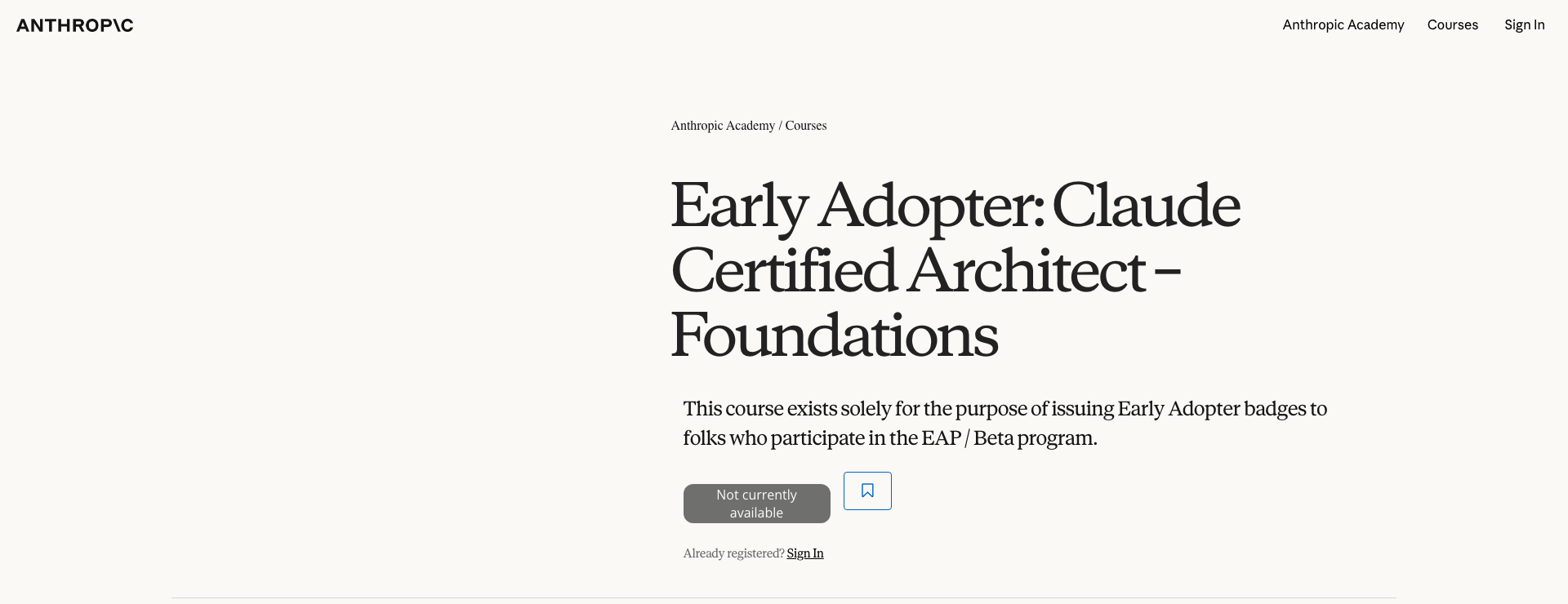
This is what grates about the early-cert market. So if you have read a confident article listing the exam as sixty questions, a hundred and twenty minutes, a specific passing score, and a specific fee, treat that with care. Anthropic still has not published a question count or passing score on its own pages, though the exam now costs $125 to purchase directly. They come from third-party certification-prep sites, and one of those sites, claudecertifications.com, has a name designed to read as official and is not. It is rubbish dressed up in serif headers. This is worth saying plainly because it is the most common way people get misled about a new certification: a vendor announces a credential, the announcement is thin, and within weeks a layer of unofficial sites fills the gap with specifics that look authoritative because nothing official contradicts them. When you research this cert, anchor on anthropic.com and the Anthropic Academy domain. If a detail is not on those, hold it loosely. The cert being early-adopter only is not a reason to ignore it. It is a reason to stop treating a beta as a settled thing.
Think about why those unofficial specifics are so easy to believe. They are not flagged as guesses. They are written in the flat, confident tone of documentation, with exact figures and a clean layout, and the human brain reads precision as credibility. A number with a decimal point feels researched even when it was invented. And because Anthropic has not posted a competing set of figures, nothing on the page gets contradicted, so a casual reader has no friction, no moment where two sources disagree and force a second look. That silence is the whole opening. The unofficial site is not lying so much as filling a vacuum, and the vacuum makes the fill look like fact.
Here is the practical cost of getting this wrong. Say an engineer reads one of those prep pages, takes the exam format as settled, and spends a month drilling against a sixty-question, hundred-and-twenty-minute model that was never confirmed. If the real exam turns out to weigh hands-on design over timed recall, that month was aimed at the wrong target. Worse, the engineer walks in with a false sense of the rules and gets rattled when the format does not match. The fix costs nothing. Before you study for any new certification, find the vendor’s own exam guide and read it first. If the vendor has not published one yet, that absence is itself the most important fact about the exam, and it should change how much you commit, not get papered over by a third party. A beta is a beta. The sober move is to wait for the vendor to say what the test is, rather than to let a confident stranger tell you.

The real offer right now
What I love about this part is that it gives anyone a real path forward today, no waitlist required. If the credential itself is not yet sittable, something adjacent to it is, and it is the part I would actually point a learner toward today. Anthropic Academy, hosted on the Skilljar platform, offers structured courses on the things the certification is built around: building with the Claude API, the Model Context Protocol, and Claude Code. That material is available now, it is free, and it does not depend on the exam opening up.
Look at what those three topics actually are, because the list is not random. The Claude API is how you wire a model into real software, which is the difference between using a chat box and shipping a product. The Model Context Protocol is how a model reaches out to tools, data, and systems instead of being stuck with whatever fits in one prompt. Claude Code is how the model becomes part of an engineer’s daily work rather than a side tab. Together they describe the practical shape of building with Claude in 2026. So the course catalog is not exam filler. It is a fair map of the skills that the certification will eventually test, which means the learning is useful on its own terms even if the exam never matters to you. You are not studying for a test. You are picking up the actual capabilities, and the test, if it comes, is just a later receipt for work you already did.
Let me step back a second. I treated the cert and the courses as one decision earlier in this post. That conflation is too compressed. They are two different decisions wearing the same name, and the right answer for one is not the right answer for the other. This is the distinction that matters when you ask “is it worth it,” and it is why I split the question. A certification has two parts. There is the learning, the actual climb in skill, and there is the credential, the badge that signals that climb to other people. People conflate them and ask about the badge. But on the learning side, the answer is immediate and clear: yes, the Anthropic Academy courses are worth your time, because Claude API design, MCP, and Claude Code are skills that pay off whether or not you ever sit an exam. You can have the entire benefit of the learning side starting today, at no cost, with no beta access required. If you are weighing how to build real AI capability in a team rather than collecting badges, that is the conversation worth having, and Blue Sheen runs engagements like this. The credential can wait. The skill should not.
A credential needs a market
After kicking this one around, the badge value comes down to whatever job market forms around it. So what about the badge itself, once it opens to everyone? Here the assessment has to be careful, because a credential has no value on its own. It only has the value a job market assigns it.
Think about what makes a certification worth holding. The AWS and Azure cloud certifications are worth holding because, after years in the market, employers list them in job postings, recruiters screen for them, and the phrase carries a shared meaning. The Claude Certified Architect has none of that yet, for the plain reason that “Claude Architect” is barely a job title. The role the cert describes, a person who architects production Claude systems, is real work and a career path still taking shape, but it does not yet have a settled name or a column in anyone’s applicant-tracking system.
It is worth being concrete about how a credential earns its keep, because the chain has several links and all of them have to hold. A recruiter has to know the cert exists. The recruiter has to believe it screens out weak candidates and keeps strong ones. A hiring manager has to agree and ask for it. Enough employers have to do this that the phrase becomes shorthand, the way “AWS Certified” already is. And the supply of holders has to be large enough that asking for it does not shrink the candidate pool to almost nobody. Break any one link and the credential stops sorting anything. The cloud certs took years to lock all of those links into place. A credential issued this season has none of them yet, not because it is weak, but because that chain is built by thousands of small hiring decisions over time, and time has not passed.
A credential for a job category that has not formed is a bet, not an asset. I’m not convinced enough buyers of this credential are pricing it as the bet it actually is. The bet might pay off. If Claude-specific architecture becomes a recognized specialty and employers start screening for proof of it, an early credential could age into something worth having early. Or the market could keep hiring “AI engineers” generally and never screen for a vendor cert at all, the way most software hiring never asks for one. There is a real argument that the second outcome is the likely one. Software hiring, at the senior end, mostly trusts work history and what you can do in an interview, not certificates. AI architecture may well settle into that same habit, in which case a Claude-specific badge stays a nice-to-have and never becomes a gate. It could also break the other way if enterprises buying Claude at scale start demanding proof their integrators are qualified, the way cloud partners get pushed toward certified headcounts. I cannot tell you which way that goes, and anyone who claims to is guessing. What I can tell you is that the credential’s worth is downstream of a job market that does not exist yet, and you should price it accordingly. Pricing it accordingly does not mean ignoring it. It means not paying asset prices for a lottery ticket, and not skipping the free learning while you wait to see how the bet resolves.
An educator’s verdict
So, as someone who teaches this material: is the Anthropic Certified Architect worth it? My answer splits exactly along the line of this post.
The learning is worth it now, without reservation. Go to Anthropic Academy, take the Claude API, MCP, and Claude Code courses, and build the skill. That return is immediate and it does not depend on any exam. The credential is worth holding off on. It is early-adopter only, its specifics are not yet published by Anthropic, and its market value is a bet on a job category still taking shape.
The split is not a dodge. It is how you should treat almost any new certification, from any vendor, at this stage of its life. Ask two separate questions and refuse to let them blur. First: does studying for this make me better at my actual work? If yes, that part is safe to act on today, because skill keeps its value no matter what the market decides. Second: will the badge be recognized and asked for by the people who hire? If you cannot answer that with evidence, the badge is speculation, and speculation is fine as long as you call it that and keep your stake small. The mistake is not chasing the credential. The mistake is paying for it as though the second question were already answered when it plainly is not.
There is also a cost to waiting, and it is fair to name it, because waiting is not free. In the conversations I keep having with senior engineers thinking about a career pivot into AI, this concern lands first. If this credential does take off, the people who sat the early exam will hold a badge with an early date on it, and an early date can read as foresight. That is a real, if modest, prize for moving first. But weigh it against the downside of moving first into a beta whose rules are not published and whose market may never form. The early-mover prize is small and uncertain. The downside is paying real money and study time for a guess. Given that the learning is free and available right now, you can capture the part that always pays and skip the part that only sometimes does. That is not timidity. It is just refusing to confuse motion with progress.
None of that makes it a bad idea. It makes it an undecided one, and the right move with an undecided thing is to keep the cost of waiting low: do the free learning, watch whether employers start asking for the credential, and sit the exam when it opens broadly and when the market has told you it means something. The good thing about this stance is how cheap it is. You give up almost nothing by waiting on the badge, and you keep all the learning. The people who will get the most from this certification are not the ones who rush the badge (they are bikeshedding their own careers, fixating on the small visible artifact instead of the bigger climb). They are the ones who did the learning early and were ready when the credential finally meant something. Be that person. The skill was always the point. The certificate is just the part that takes a market to ratify, and markets take their time.