Key takeaways
- The practice runs from files, not memory - a version-controlled folder Claude Code reads each session, with Close CRM as the source of truth for client state
- AI drafts, a human sends - every prospect and client email is written in my voice as a Close draft and never sent automatically
- Delivery is spec, build, validate, fix - I write a spec, Claude Code builds the agent, then I check it file by file with the client before anything ships
- The gate stays human - the recommendation, the price, the send, and the sign-off are mine; the tasks in between are the AI's
My entire consulting practice fits in a folder on my laptop.
Not a metaphor. A directory, under version control, that Claude Code reads at the start of every working session. Every client, every proposal, every meeting note, every half-built agent sits in it. The files are the memory. Close CRM holds the record of who is who and what was last said. Claude does most of the typing.
I run Blue Sheen, an AI advisory firm, with my co-founder Pravina. Two of us. No junior associates to hand things to, no research team down the hall. So I had to answer the question every solo operator is now asking: how much of this can the AI carry?
The real answer, after a couple of years of running it this way, is narrower than the hype and more useful. AI does the tasks. I own the judgment and the gate. It drafts the email; I decide whether it goes. It builds the first cut of a client agent; I am the one who checks it against reality. That single split is the operating model, and it is the same point I argued in AI does tasks, not jobs. What follows is what it looks like on an ordinary day.
Files are the memory
Start with the thing that makes the rest work. Everything lives in plain files.
Each client is a folder. Inside it: a CLAUDE.md that tells any session the rules for that account, meeting notes by date, a research folder, a delivery folder with one subfolder per project, and a reference folder for the durable facts. Knowledge that every client should inherit sits one level up, in a shared reference folder. When a workflow breaks, I write the fix down once, as a rule, and every future session reads it. I do not use the AI’s own memory feature for any of this. Memory you cannot grep is memory you cannot trust. Files are version-controlled, diffable, and they move between my two machines without ceremony.
The reason it moves without ceremony is a rule I keep: one unit of work is one commit. A unit is either committed and done, or not committed and discarded, so a session that dies leaves no half-finished mess to untangle, just the last clean commit. The other machine pulls that history and picks up exactly where it left off, because the commits are the state. Nothing important lives in a session that only one laptop saw.
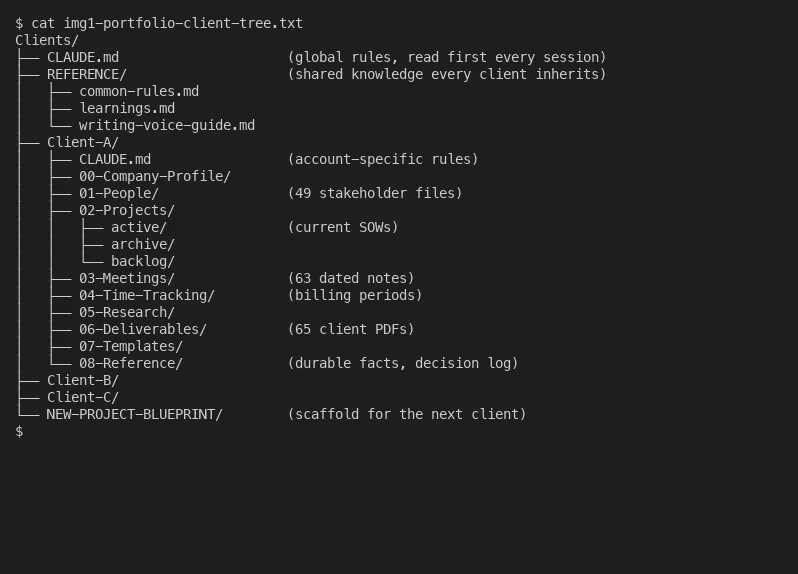
One real client folder, name stripped out. The numbered subfolders are the memory every session reads, and the shared rules sit one level up in REFERENCE.
Close CRM is the other half. It is the source of truth for who a person is, what we last said, what is scheduled. Every client folder is hard-linked to a Close lead by ID. Nothing happens in a session until that link resolves.
So the first thing every session does is catch up. Before I ask for any work, Claude pulls the lead record, the meetings in the next two weeks, the open tasks, the last ten emails, and the recent notes, all in one go, then hands me five bullets and asks whether any of it changes what I want to do. Read-only. It never posts during the catch-up. It just tells me where things stand, the way a good chief of staff would before you walk into a room.
Finding work and selling it
Prospecting is where people expect the most AI and should want the least.
The automated part is this. When I target a company, I build a list of the handful of people worth talking to across the buyer roles, hand it to Claude Code, and it researches each person and drafts outreach shaped to that role. A founder reads differently from a head of operations. The drafts reflect that. Company-specific context, a recent regulatory change, a pressure their industry is under, gets merged into the sequence without rewriting the parts that already work.
The part I keep by hand is the rest, on purpose. I curate the list. I approve every message. And every new email sequence goes to a throwaway test inbox first, as contact number one, so I can see how it renders before a real person ever does. That habit came from being burned. The discipline is cheap. Looking sloppy to a prospect is not.
The strategy underneath this, who to target and how to position, I wrote up separately in starting an AI consulting practice. This is the execution layer beneath it.
CRM is where the draft-not-send rule earns its keep. Every email I send a prospect or a client is created through the Close API as a draft, in my voice, and I read it and send it by hand. A checklist runs before the draft is even staged: replies have to thread to the message they answer, so they do not show up as a new conversation; if the body says five documents are attached, the attachment list has to actually contain five; the subject line and the body get scanned for the words I never use and the tells that make writing read like a machine produced it. Routine replies stay short, around a paragraph, with no numbered lists where a sentence would do.
None of that decides what to say. It catches the mechanical ways a good message gets quietly wrecked. The actual call on what this client needs to hear is mine. When the work is about structuring the engagement itself, the discovery sprint, the pricing, where the pivots are allowed, that is the engagement model, and it is a human decision every time.
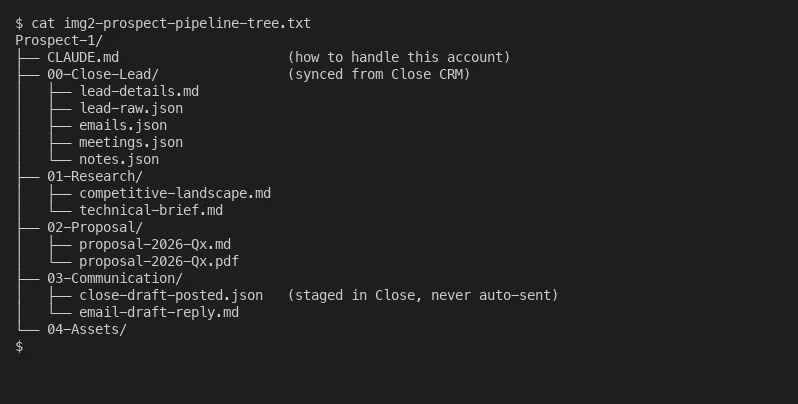
A prospect is a folder too. The Close lead syncs in, the proposal goes out, and the reply waits as a draft in Close that I read and send by hand.
Research and proposals
Two things happen before a proposal exists: I learn the prospect cold, and I check every claim I am about to make.
The research is AI-heavy and I am fine with that. Before a first call I have a background file on the person and the firm, their arc, their mandate, what they are likely to care about. Fast cited research is what makes this affordable for a two-person shop; I wrote about where that kind of tool helps and where it quietly fails in Perplexity for business research. The short version is that it collapses the hours of gathering and does nothing to remove the hour of verifying.
Because verifying is the rule that does not bend. Every load-bearing fact going into something a client will read gets confirmed against a primary source, checked live, before it goes in. If I cannot confirm it, I ask. I do not guess. I learned that the slightly painful way once, when a tidy hypothesis I was sure of fell apart the next morning against the actual data. Now the AI is told to verify before it asserts, and to survey a whole set before it draws a conclusion from one example.
The proposal itself is mostly assembled, not hand-built. It is written in plain markdown and rendered through a pipeline into a branded PDF, cover page and all, with brand-styled diagrams generated from text. The same pipeline produces guides and monthly reports, so I maintain it once and reuse it everywhere. Every proposal follows one skeleton: the prospect’s situation mirrored back in their own words, the recommendation first, a phase-one scope, an indicative timeline, pricing with terms, what I need from them, and an upfront list of risks and unknowns. Before it renders, a checklist scans the title and every heading, not only the body, for banned words and for any claim I cannot stand behind. I never let it imply a certification I do not hold or a capability I have not built.
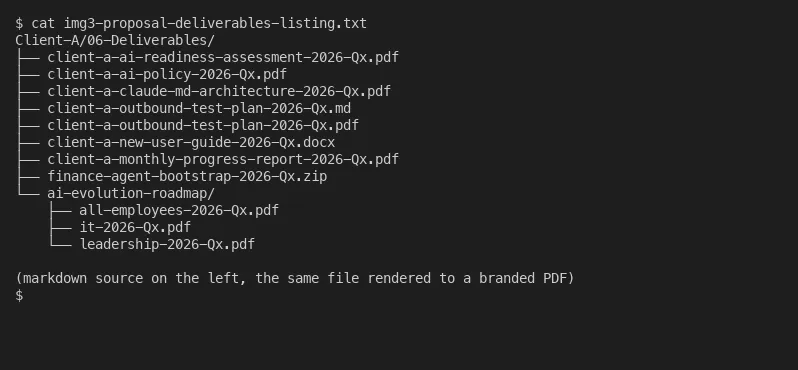
One client’s deliverables. Each file is written in markdown and rendered to a branded PDF by the same pipeline, which is how a two-person shop keeps up.
This is the part that surprised me most about working solo with these tools. A good chunk of what used to need a junior associate, the research pass, the first draft, the formatting, the consistency, is now the kind of expertise AI multiplies, for one person instead of a team. The associate I do not have is not a gap anymore. It is a script.
How I build what I deliver
Delivery is where the word agent stops being marketing and turns into a thing with bugs.
Most of what I deliver is a working agent for a client, scoped to one job. A chief-of-staff agent for an executive team. A contract-risk reviewer for a finance function. An outbound prospecting agent like the one I run for myself. The pattern is the same every time, and it is not one-shot.

I write a detailed spec. Then Claude Code builds against it, sometimes overnight, and produces a working scaffold: the dashboards, the scoring logic, the staged emails, the action register. Then comes the part that matters most, which is sitting with the client and walking the thing file by file against reality. The first build of an agent has real bugs. The first one I shipped misclassified things in ways that were obvious the moment a human who knew the domain looked at it. We catch them in review, and Claude Code fixes them in a single pass that also migrates the files and writes the onboarding guide. Then we look again.
That loop, build then check then fix, is doing the same job that parallel verification does inside a dynamic workflow when a job is too big to eyeball. On the largest delivery jobs I reach for exactly that, many agents checking each other before anything reaches me. On a normal one, the checker is a person who knows the business, sitting next to me.
A lot of the real work is handing the controls over. I install Claude Code or the desktop app on the client’s machines, set up their own folder rules so their sessions inherit the right context, and get their first users running. When I am putting Claude in front of an operations team that has to trust it, the adoption playbook is its own subject, and I wrote it down in Claude for operations teams. The agent I built is not the deliverable. A team that can run and change it without me is.
What I still own
Add up the stages and a shape appears. The AI does the tasks. The tasks are the typing, the research, the building, the rendering, the summarizing. What it does not do is decide.
It does not pick the recommendation or set the price. It will not send the email, sign off the proposal, or tell a client something is true. Those are the points where being wrong has a cost that lands on me, so those are the points I keep. Even my meeting notes work this way: the calls run on Zoom, a tool summarizes them, the notes go into the client folder in a fixed shape, and they stay internal. They are for me, not for quoting back. Invoices run through Xero, and I have learned not to let the AI predict an invoice number, because it will, with great confidence, be wrong. The numbering is one global sequence I do not control.
So the question is not whether the AI can run a consulting practice. It cannot, and the people promising it can are selling the part that does not exist. The useful question is how much of the practice it can carry while a person keeps the judgment. The answer, for me, is most of it. I get the output of a small team and I keep the one job that was always mine, which is deciding what is right for the client in front of me.
That setup, the operating system and not a demo, is the work Pravina and I do for other firms through Blue Sheen. But the setup is not the point. The point is the part you do not hand over. Build the practice so the AI carries the tasks, and guard the judgment like it is the only thing you sell. Because it is.